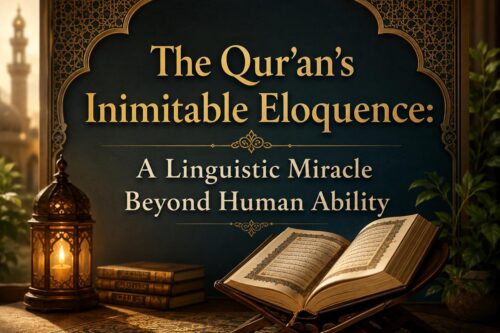
The Qur’an occupies a unique place in Arabic literature and Islamic belief. Muslims hold that its language is i’jāz al-Qur’ān (the inimitability of the Qur’an), meaning that its eloquence, structure, and rhetorical power cannot be replicated by human beings. This conviction has been a central aspect of Islamic thought since the Qur’an’s revelation in the seventh century.
The Qur’an challenged its contemporaries—many of whom were renowned poets and orators—to produce a chapter like it if they doubted its divine origin. Several verses present this challenge, including:
“And if you are in doubt about what We have sent down upon Our Servant, then produce a surah like it and call upon your witnesses other than Allah, if you should be truthful.” — Qur’an 2:23
Classical Muslim scholars argued that this challenge remains unmet because the Qur’an combines multiple literary qualities in a way unmatched in Arabic. Among the features they highlighted are:
* Exceptional eloquence: The Qur’an employs precise word choice, vivid imagery, and powerful rhetorical devices while maintaining clarity. * Unique style: Its language does not conform to the established genres of pre-Islamic poetry or prose, occupying a distinctive literary form. * Linguistic precision: Many verses convey profound meanings with remarkable brevity, while others develop complex ideas through carefully structured repetition and parallelism. * Rhythm and sound: The phonetic patterns, cadence, and recitation contribute significantly to its impact, even apart from its semantic content. * Consistency across themes: Despite addressing law, theology, history, ethics, and spirituality over approximately 23 years of revelation, the Qur’an maintains a coherent style and message.
Historically, the Qur’an had a profound influence on the development of Arabic language and literature. Its vocabulary, grammar, and rhetorical techniques became foundational for later linguistic and literary scholarship.
From an academic perspective, the Qur’an is widely recognized as one of the most influential works in Arabic literature, and many scholars—Muslim and non-Muslim alike—have commented on its literary sophistication and enduring impact. However, whether its eloquence constitutes a miracle beyond human ability is ultimately a matter of religious belief rather than an empirically testable claim. Muslims affirm that its inimitability is evidence of its divine origin, while others may appreciate its literary qualities without accepting that theological conclusion.
Thus, the Qur’an’s linguistic inimitability can be understood in two complementary ways:
* Within Islamic theology: It is a divine miracle and proof of prophethood. * Within literary scholarship: It is an extraordinarily influential and distinctive work of Arabic literature whose style has shaped the language for centuries. ………………….. The linguistic miracle of the Holy Qur’an is regarded as one of its greatest aspects of miraculousness. It is the secret that astonished the eloquent Arabs and the masters of rhetoric from the moment it was revealed, leaving them unable to produce anything comparable, despite their unmatched mastery of language, poetry, and oratory.
The Holy Qur’an is a unique linguistic and literary miracle, distinguished by its extraordinary eloquence, unparalleled precision, and remarkable structure—qualities that no human being has been able to replicate. Allah says: “فَإِذَا قَرَأْنَاهُ فَاتَّبِعْ قُرْآنَهُ * ثُمَّ إِنَّ عَلَيْنَا بَيَانَهُ” (القرآن 75: 18–19) Then when We have recited it, follow its recitation. Then upon Us is its explanation Its miraculous nature encompasses numerous dimensions, extending from its phonetic beauty and captivating auditory qualities to its comprehensive narrative structure across chapters and verses. It is reflected in the unique organization of events, themes, and messages according to an unparalleled divine system that humanity has been unable to imitate. The Qur’an challenges both mankind and jinn to produce even a single chapter equal to it in eloquence, depth, and meaning. This challenge has remained unanswered for more than fourteen centuries. Allah says: {قُل لَّئِنِ اجْتَمَعَتِ الْإِنسُ وَالْجِنُّ عَلَىٰ أَن يَأْتُوا بِمِثْلِ هَٰذَا الْقُرْآنِ لَا يَأْتُونَ بِمِثْلِهِ وَلَوْ كَانَ بَعْضُهُمْ لِبَعْضٍ ظَهِيرًا}. Say, if mankind and the jinn gathered together to produce the like of this Qur’an, they could not produce its like, even if they were to help one another.” (Qur’an 17:88) then The challenge was subsequently reduced to producing ten surahs comparable to it. Allah says: ﴿أَمْ يَقُولُونَ افْتَرَاهُ ۖ قُلْ فَأْتُوا بِعَشْرِ سُوَرٍ مِّثْلِهِ مُفْتَرَيَاتٍ وَادْعُوا مَنِ اسْتَطَعْتُم مِّن دُونِ اللَّهِ إِن كُنتُمْ صَادِقِينَ﴾, “ Or do they say, “He invented it”? Say, “Then bring ten surahs like it that have been invented and call upon [for assistance] whomever you can besides Allah, if you should be truthful.” he challenge was not limited to producing ten verses; rather, they were even challenged to produce just a single surah. Allah says: ﴿ وَإِن كُنتُمْ فِي رَيْبٍ مِّمَّا نَزَّلْنَا عَلَىٰ عَبْدِنَا فَأْتُوا بِسُورَةٍ مِّن مِّثْلِهِ وَادْعُوا شُهَدَاءَكُم مِّن دُونِ اللَّهِ إِن كُنتُمْ صَادِقِينَ﴾ And if you are in doubt concerning that which We have sent down (i.e. the Quran) to Our slave (Muhammad ﷺ), then produce a Surah (chapter) of the like thereof and call your witnesses (supporters and helpers) besides Allah, if you are truthful. Among the most prominent aspects of the Qur’an’s linguistic miracle are:
Precision in word choice: Every word is placed with perfect accuracy. Replacing any word with another would either alter the intended meaning or diminish its rhetorical impact. The beauty of its composition: The words and sentences are arranged in a remarkable harmony that combines the depth of meaning with the elegance of expression. Brevity with profound meaning: The Qur’an conveys vast and profound concepts through concise yet powerful language. Perfect harmony between wording and meaning: Its language perfectly suits each context. Verses of mercy are expressed with tenderness and gentleness, while verses of warning and punishment carry a powerful and commanding tone. Unique verbal rhythm: The Qur’an possesses a distinctive cadence that deeply touches the hearts, although it is neither poetry nor conventional prose.
Freedom from contradiction: Although the Qur’an was revealed gradually over a period of twenty-three years, it remains perfectly consistent in its language, meanings, and rulings.