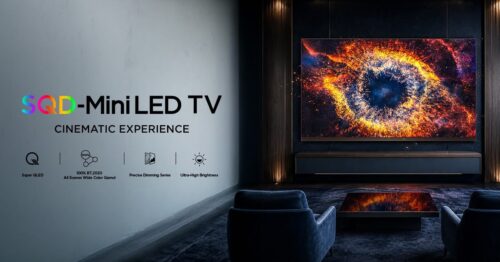
TCL, a global leader in consumer electronics and one of the world’s largest display manufacturers, is highlighting the display engineering behind its SQD-Mini LED TV technology as consumers continue to navigate an increasingly crowded premium television market. With OLED, QLED, Mini LED and RGB-Mini LED technologies competing for attention, understanding how each display architecture actually manages colour, brightness and contrast has become increasingly important. Unlike OLED, where individual pixels generate their own light, QLED televisions retain an LCD foundation with LED backlighting and use quantum dots to enhance colour. Mini LED takes the LCD approach further by using significantly smaller LEDs, allowing manufacturers to create more dimming zones and achieve finer control over local contrast. RGB-Mini LED goes another step by using separate red, green and blue LEDs in the backlight, but this can introduce colour crosstalk around high-contrast boundaries. TCL’s SQD-Mini LED TV takes a different route. Rather than relying on separate RGB LEDs to generate colour, its blue LED backlight activates quantum dots to produce highly pure red, green and blue light. The resulting output is then refined through the Ultra Color Filter, helping minimise RGB colour crosstalk and improve colour accuracy. The architecture supports an ultra-wide colour gamut of up to 100% BT.2020. The technology combines three core elements: Super QLED quantum dot material innovation, Super Backlight powered by Precise Dimming Series, and the Super Panel platform. Together, these elements address light, colour and contrast at the display level rather than relying solely on processing software. Precise Dimming Series is central to this approach, with TCL stating that it can provide up to three times the dimming precision of an RGB-Mini LED display using the same LED package count. On the flagship X11L SQD-Mini LED TV, this architecture is paired with more than 20,000 local dimming zones and peak brightness of up to 10,000 nits. The result is a display architecture designed to manage several aspects of picture performance simultaneously: broad colour reproduction, precise control of bright and dark areas, high highlight intensity and large-screen picture quality.
For consumers, the distinction is therefore not simply between competing names such as OLED, QLED or Mini LED. It is increasingly about understanding how the underlying display architecture generates and controls light, colour and contrast — and how those elements work together in the finished television.