
















Ahmed Alzahrani _ Saudi Arabia
The Kingdom of Saudi Arabia is considered one of the countries that has successfully showcased its cultural and civilizational heritage on the international stage by registering a number of its historical sites on the World Heritage List of the United Nations Educational, Scientific and Cultural Organization (UNESCO). This global recognition reflects the depth and diversity of Saudi history, attracting researchers and tourists from around the world.
The inclusion of these sites and others on the UNESCO list is not limited to their preservation alone; it also contributes to strengthening national identity, supporting cultural tourism, and passing this heritage on to future generations. Saudi Arabia continues its efforts to discover and document more of its heritage sites, affirming its position as a global cultural destination that blends authenticity with renewal
• . Saudi sites in UNESCO:
• 1-Al-Hijr (Madain Saleh)
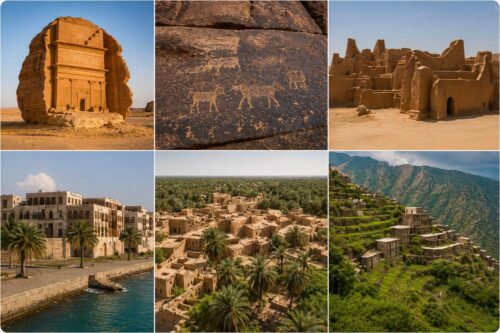
• The first Saudi site to be added to the UNESCO World Heritage List in 2008 CE, this enchanting place is located in the AlUla region, which was once part of the Nabataean Kingdom. What distinguishes Madain Saleh is its 153 intricately carved rock-cut facades, reflecting the magnificence of Nabataean architecture. This ancient city tells the story of a flourishing era of trade and culture, as it once served
• as a vital station along the ancient Incense Route.
2-Al-Turaif District in Diriyah
n 2010, the At-Turaif District was inscribed as a UNESCO World Heritage Site, becoming a living testament to the birthplace of the First Saudi State. This historic district in Diriyah reflects the splendor of traditional Najdi mud-brick architecture and is home to numerous heritage buildings that once served as the center of governance and politics in the 18th century. Diriyah was built as a fortified settlement, embodying a spirit of resilience and. pride Today, the At-Turaif District is considered one of the most remarkable archaeological sites, offering visitors a journey back in time to the era of the Saudi state’s foundation, where heritage and authenticity meet in every corner.
Historic Jeddah( Al-Balad) . 3-
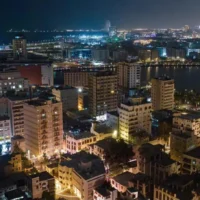
In 2014, Historic Jeddah, also known as “Al-Balad,” was inscribed on the UNESCO World Heritage List. This historic area reflects the cultural, commercial, and civilizational interactions that Jeddah has witnessed throughout the ages, as it served as a major gateway for trade and pilgrimage. It is famous for its narrow alleyways and buildings constructed from coral stone and wood, telling stories of maritime life, trade, and the diverse cultures that met and interacted here—making it a living testament to the rich Hejazi heritage.
4 Hima Cultural Area –
A global archaeological site located in the Najran region of southern Saudi Arabia, it was inscribed on the UNESCO World Heritage List in 2021.
It is home to thousands of rock carvings and drawings dating back to prehistoric times. The site represents an open-air “rock library” containing hundreds of thousands of petroglyphs and rock paintings that document human civilizations, hunting practices, and climate changes over a period extending back to 7000 BC.
5 Rock Art in Jubbah and Shuwaymis —
In the heart of the Hail Desert, rock drawings and engravings dating back thousands of years stand as one of the oldest rock art forms in the world. These artistic masterpieces were inscribed on UNESCO’s World Heritage List in 2015, transporting us back to prehistoric times.
These drawings depict the life of early humans and their relationship with nature and animals, embodying the details of their daily lives and interactions with their environment. These engravings are not merely simple drawings, but rather eloquent historical documents that tell the stories of civilizations that lived here and left their indelible mark on the rocks, remaining as witnesses to the richness of history and the spirit of human creativity.
6–Al-Ahsa Oasis
Located in the Eastern Province of Saudi Arabia, Al-Ahsa Oasis is the largest palm oasis in the world and was listed as one of the Saudi archaeological sites by UNESCO in 2018. This green oasis is rich in a number of archaeological sites and charming natural landmarks, and is a living example of the sustainability of life in the heart of the desert, due to the traditional irrigation systems and agriculture that have flourished here over the centuries.
7 Uruq Bani Ma’arid Reserve -.
Located in the heart of the Rub’ al Khali desert, the Uruq Bani Ma’arid Reserve, inscribed on the 2023 World Heritage List, is considered a stunning environmental treasure. This reserve embodies the beauty of nature and the diversity of wildlife, including rare and endangered species such as the Arabian oryx and the sand gazelle. Its UNESCO inscription strengthens efforts to protect it and maintain its ecological balance, encouraging research and study. A visit to the reserve offers a unique opportunity to witness the interaction of wildlife with the harsh desert environment and enjoy its ever-changing natural beauty.
8- Al-Faw Archaeological Area –
The Al-Faw archaeological village was included in the UNESCO World Heritage List in 2024 as a cultural site of outstanding universal value for human heritage. It is located in Wadi Al-Dawasir Governorate, south of the Riyadh region, and extends over a protected area of 50 km2, surrounded by a buffer zone of 275 km2, at the intersection of the Empty Quarter desert and the topography of the Tuwaiq mountain range, which forms a narrow passage called “Al-Faw.” This historical village, which was known in ancient times as “Dhat Kahl,” embodies a great civilization that flourished between the fourth century BC and the fourth century AD, and was an important commercial and cultural center for the ancient Kingdom of Kinda.