













Houimli Soufian
Company announces scale-up to 32 production lines by 2030, backed by 44 years of presence, three Made-in-Saudi factories, and an end-to-end offer spanning AI infrastructure, SF6-free grid technology, building decarbonization, and industrial digitalization.
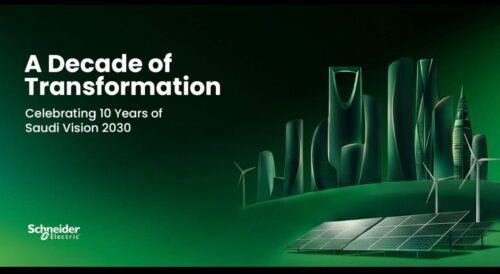
Riyadh, Saudi Arabia, 25 April 2026 — Schneider Electric, the global energy technology partner, today marks the tenth anniversary of Saudi Vision 2030 by announcing its commitment to nearly tripling its Saudi manufacturing capacity to 32 production lines by 2030, reinforcing its position as one of the Kingdom’s most deeply invested international industrial partners across manufacturing, digital infrastructure, clean energy, and human capital development.
The announcement comes as Saudi Arabia celebrates a decade of measurable national transformation. With over 44 years of uninterrupted presence in the Kingdom since 1981, more than 8,000 government and private sector clients, and more than 350 certified partners. Schneider Electric has been an active delivery partner across every major pillar of Vision 2030, from industrial manufacturing and grid modernization to smart buildings, data centers, and digital operations.
Schneider Electric today operates three manufacturing facilities in Riyadh and Dammam, covering more than 35,000 square metres of production and logistics space. The company’s newest facility, built within King Salman Energy Park in the Eastern Region, was designed from the ground up to reduce energy consumption by 33% and carbon emissions by 34% compared to conventional industrial construction. An adjacent 7,000 square metre IoT-enabled distribution center in Riyadh serves the company’s partner network across the Kingdom.
Products manufactured in Saudi Arabia include the Galaxy UPS critical power system, Prisma low-voltage switchboards, Acti9 Disbo residential distribution boards, Lauritz Knudsen low-voltage switchgear, McSet medium-voltage switchgear, WS-G Medium Voltage GIS switchgear and HVX / EVO Pact Medium Voltage Vacuum Circuit breaker. These products are not manufactured for local consumption alone. They compete in global supply chains, representing a Saudi industrial capability that extends well beyond the Kingdom’s borders.
The commitment to nearly triple production lines to 32 by 2030 represents one of the most concrete private sector manufacturing scale-up commitments made in alignment with Vision 2030’s industrial localization agenda.
Global demand for data center capacity is projected to quadruple between 2023 and 2030, with Saudi Arabia positioning itself as the regional hub for this growth through major investments in AI compute infrastructure, cloud services, and digital government initiatives.
As the world’s leading provider of data center solutions, Schneider Electric supports this ambition with a comprehensive portfolio spanning power, cooling, software, and services, underpinned by a strong manufacturing footprint in the Kingdom. This includes locally manufactured 3 phase UPS systems, cooling chillers, and prefabricated data centers, complemented by the broadest certified partner ecosystem.
Schneider Electric delivers end to end, AI ready infrastructure – from grid to chip & Chip to Chiller – covering medium and low voltage layers supported by UPS, PDUs, advanced metering, and SBESS. Advanced thermal management, including air and liquid cooling, high performance chillers, and modular prefabricated solutions, is integrated with a digital software suite – BMS, EPMS, and ETAP digital twin – to optimize the full data center lifecycle for performance, resilience, and sustainability.
Schneider Electric is bringing SF6-free switchgear technology to Saudi Arabia’s grid infrastructure through its AirSeT range, which replaces SF6, a greenhouse gas with 23,500 times the warming potential of CO2, with pure air technology. The SM AirSeT and RM AirSeT product lines bring digital, sustainable medium-voltage switching to buildings, secondary distribution networks, and renewable energy installations across the Kingdom.
As Saudi Arabia advances its commitments under the Saudi Green Initiative to reduce carbon emissions by 278 million tonnes by 2030 and plant ten billion trees across the region, clean grid infrastructure is a critical enabler. Schneider Electric’s SF6-free portfolio makes the sustainability agenda operational at the grid level, not only at the corporate reporting level.
Saudi Arabia’s commercial real estate, healthcare, hospitality, and retail sectors represent a significant and largely untapped opportunity for building-level energy transformation. Through its Digital Energy business, Schneider Electric is deploying integrated Digital Building Management and Power Management Solutions that reduce energy consumption, lower operating costs, and enable building owners to meet the Kingdom’s evolving sustainability requirements.
The renovation and retrofit market is growing rapidly as existing buildings seek to meet new efficiency standards without full reconstruction. Schneider Electric’s EcoStruxure Building platform integrates power, HVAC, lighting, and security into a single management layer, delivering energy reductions that have reached 30% in comparable deployments globally. In a market where energy costs and carbon accountability are rising simultaneously, building intelligence is no longer a premium option. It is a commercial necessity.
In Diriyah, Schneider Electric is deploying a centralized intelligent smart city platform powered by the AVEVA platform, that integrates big data analytics, machine learning, and smart city technologies to enhance both operations and the experience of residents and visitors. The platform brings together real-time data streams to enable predictive management, optimize energy and resource consumption, and support the seamless delivery of services at scale.
This innovation-driven approach reflects the broader potential of smart city thinking applied to Saudi Arabia’s most ambitious destination projects. As the Kingdom advances its digital transformation agenda, the convergence of data intelligence, connected infrastructure, and human-centered design is what distinguishes a truly world-class destination from one that is merely well-built. Heritage and innovation are not in tension. They are mutually reinforcing.
Schneider Electric’s contribution to Saudi human capital development extends well beyond its own workforce. The company has invested more than 50 million US dollars in Saudi Arabia over the past five years and employs more than 700 people in the Kingdom, with its Riyadh manufacturing facility reflecting a strong representation of Saudi nationals across its workforce.
Through its EcoXpert partner certification programme, Schneider Electric develops the technical capability of Saudi partner companies and their engineers, enabling local businesses to independently design, install, and maintain advanced energy and automation systems. Every EcoXpert-certified partner in the Kingdom is a Saudi business that Schneider Electric has trained to compete and grow. The company’s 350-plus certified partners across the Kingdom represent the multiplied effect of that investment, a network of Saudi technical capability that Vision 2030’s private sector development goals depend on.
Mohamed Shaheen, Chief Executive Officer of Schneider Electric in Saudi Arabia, Pakistan, Bahrain and Yemen, said: “Ten years of Vision 2030 have proven something that matters: Saudi Arabia does not just set ambitions, it delivers on them. What I have seen in five years leading this business in the Kingdom is a country that builds with discipline and purpose. Our commitment to nearly tripling our manufacturing capacity by 2030 is not a marketing statement. It is a production plan that is already underway. We are here for the next decade of this transformation exactly as we were here for the last.”
As Saudi Arabia enters the second decade of Vision 2030, Schneider Electric reaffirms its commitment to building alongside the Kingdom, in its factories, in its grid, in its data centers, and in its people.
— End —